
Aloe Vera Moisturizer in Pakistan: Research and Our Gel
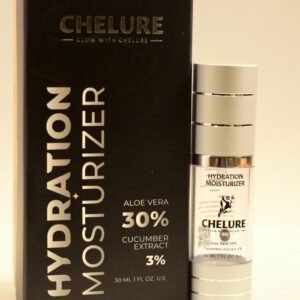
Short answer: Aloe vera is a plant whose inner leaf gel is mostly water and is traditionally used to soothe and hydrate skin. Reviews describe many biological activities, but the quality of skin evidence varies, and most of it is not about face moisturizers. Our Hydration Moisturizer lists 30% aloe vera juice and 3% cucumber extract in a light water-based gel for Rs 2,200.
Key takeaways
- Aloe in a moisturizer is a soothing, water-rich base ingredient, not a treatment.
- Percentage matters: we print 30% aloe vera juice on the label.
- A water-based gel suits oily, humid-weather skin, but it is not oil-free: ours has a small amount of avocado oil.
What aloe vera is
Aloe vera is a succulent whose leaf contains a clear gel rich in water, sugars and other plant compounds. A 2024 comprehensive review (Foods, PMID 38998660) collects recent studies on its activities and the compounds thought responsible, and describes its use in cosmetic and medicinal products, including for skin disorders. It also describes aloe as a field of ongoing research rather than a settled treatment.
What the research says
| Source | What it covered | What it found |
|---|---|---|
| Aloe vera extensive review, Foods 2024 (PMID 38998660) | Recent studies on aloe’s compounds and activities | Many reported activities; research continues |
| Topical aloe vera gel for split-thickness skin graft donor sites, Plast Reconstr Surg 2018 (PMID 29649056) | Double-blind trial in wound healing | A wound-care study, not a facial moisturizer study; shown only to illustrate the research base |
| Cucumber phytochemical and therapeutic review, Fitoterapia 2013 (PMID 23098877) | Review of cucumber compounds | Describes plant compounds and traditional uses; skin evidence is limited |
How to read it: evidence for aloe in everyday face moisturizers is mostly traditional use and small studies. We say that plainly and do not claim treatment effects.
Why Chelure’s Hydration Moisturizer uses aloe and cucumber
- 30% aloe vera juice: a large water-based, cooling base that gives a light, non-greasy feel.
- 3% cucumber extract: adds to the soothing, fresh feel.
- Low and high molecular-weight hyaluronic acid: water binding (see our hyaluronic acid guide).
- Peptides and niacinamide: firmness and barrier (see their hubs).
- A small amount of avocado oil: comfort; it is not oil-free.
What happens when they are combined
No trial exists of this exact formula. The reasoning is that a water-rich base with humectants hydrates without heaviness, niacinamide supports the barrier, and aloe and cucumber give a calming feel after acids, retinol or hot, humid days.
Price comparison
| Product | Size | Price | Per mL |
|---|---|---|---|
| Chelure Hydration Moisturizer | 30 mL | Rs 2,200 | about Rs 73 |
Delivery is a flat Rs 250 across Pakistan.
What aloe vera gel is, and which part matters
The aloe plant has two parts that matter in skincare. The bark of the leaves contains anthraquinones, which have strong effects and a considerable toxic potential, while the clear gel from the centre of the leaf is almost entirely made of carbohydrates, and that gel is what well-made cosmetic products use (PMID 16364121). That is why a finished aloe moisturizer is different from a home-made preparation that includes the leaf skin, and why we list aloe vera juice as an ingredient rather than selling raw plant material.
Allergy and irritation: rare, but possible
In a patch-test study of 702 consecutive patients, none reacted to an oily leaf extract, a whole-plant powder or concentrated aloe vera gel, and the authors suggested carbohydrates are unlikely to cause contact allergy (PMID 16364121). Even so, allergic reactions to aloe do happen: one case report describes a woman with dermatitis on her legs after using home-made aloe juice, with positive patch tests to the aloe leaf and jelly (PMID 17868225). If you have a known plant allergy, patch-test any aloe product on the inner forearm for a few days first.
Aloe in combination with an acne treatment
In an 8-week randomized, double-blind trial in 60 people with mild to moderate acne, tretinoin 0.05% cream plus a 50% aloe vera gel reduced inflammatory, non-inflammatory and total lesion counts significantly more than tretinoin plus a plain base, and redness was less severe in the aloe group (PMID 23336746). That is a trial of a specific 50% gel used alongside a prescription retinoid. Our moisturizer contains 30% aloe vera juice, so it is not the same product, but the finding supports the idea that a soothing, water-based layer fits well with active acne treatment.
Choosing a water gel or a cream
| Your skin | What usually works | Add if needed |
|---|---|---|
| Oily or combination, humid weather | A water-based gel in the morning and evening | Nothing, or a thin layer more only on dry patches |
| Normal, air-conditioned rooms | Gel by day, a slightly richer layer at night | A cream over the gel when skin feels tight |
| Dry, or using retinol or acids | Gel under a cream at night | A richer night cream; patch-test new products |
| Sensitive or prone to reactions | Fragrance-free gel, introduced alone | Patch-test for several days first |
Our guide to oil-free lotion versus water-gel moisturizer and how to choose a moisturizer cover the choice in more detail, and our summer routine for Karachi shows where a gel fits in hot weather.
What the evidence does and does not show
A 2024 review of aloe vera lists many reported biological activities and says research continues (PMID 38998660). Much of that research is on oral or wound-healing uses, not on aloe as an ingredient in a face moisturizer. We include aloe and cucumber for a cooling, soothing, water-rich base, and we do not claim that they treat acne, remove marks or change skin tone.
Reading the label: aloe barbadensis leaf juice
- On an ingredient list, aloe vera juice is usually written as aloe barbadensis leaf juice. Where it appears in the list tells you roughly how much there is, and a percentage is better still.
- Our moisturizer prints 30% aloe vera juice and 3% cucumber extract on the product page.
- Aloe vera juice and aloe vera gel are not identical. Juice is thinner and watery, gel is thicker. A finished moisturizer combines them with other ingredients.
Common mistakes with aloe moisturizers
- Using the cut leaf directly on the face. The leaf skin contains compounds that are not meant for skin products.
- Expecting aloe to clear acne or fade marks. It is a soothing, water-rich base ingredient.
- Using it as the only moisturizer in air-conditioned or dry conditions, where a richer layer on top may be needed.
- Skipping a patch test if you have a plant allergy.
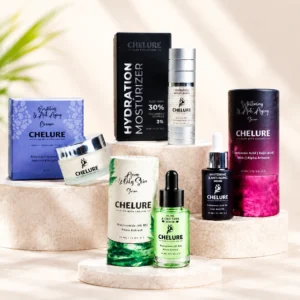
Complete Range: All 4 Chelure Products
How to use it
Morning and night; after serums; before sunscreen; patch-test if you have plant allergies.
Who should speak to a doctor first
Known aloe or plant-extract allergy, eczema, open or broken skin, or a rash that does not settle.
Frequently asked questions
Is aloe vera good for oily skin?
A water-based aloe gel feels light and does not leave a heavy film, which suits oily skin in humid weather. Aloe is a soothing base ingredient, not an acne treatment. Ours also contains hyaluronic acid, niacinamide and a small amount of avocado oil, so it is not oil-free.
Can I use pure aloe gel as a moisturizer?
Pure aloe gel is mostly water and can feel cooling, but on its own it gives hydration without the other ingredients a finished moisturizer carries. Ours lists 30% aloe vera juice plus hyaluronic acid and niacinamide. Patch-test if you have plant allergies.
Does aloe vera clog pores?
Aloe gel itself is water-based and not oily, so it is not expected to clog pores on its own, but we do not have a study that proves this for our formula. Ours contains a small amount of avocado oil. If you are very breakout-prone, patch-test first.
What does cucumber extract do for skin?
Cucumber extract adds to the cooling, fresh feel of a water-based gel. A review describes cucumber’s plant compounds and traditional uses, but evidence for skin effects is limited. We include it at 3% for a soothing feel, not as a treatment.
Is a water-gel moisturizer enough in Karachi’s humidity?
A water-gel moisturizer is generally comfortable in humidity for many oily and combination skin types. If your skin is dry, you sit in air-conditioned rooms, or you use retinol or acids, you may need a richer layer at night. Sunscreen is still needed every morning.
Sources
- Catalano A et al. Aloe vera-An Extensive Review Focused on Recent Studies. Foods, 2024. PubMed 38998660
- Burusapat C et al. Topical Aloe Vera Gel for Accelerated Wound Healing of Split-Thickness Skin Graft Donor Sites: A Double-Blind, Randomized, Controlled Trial and Systematic Review. Plast Reconstr Surg, 2018. PubMed 29649056
- Mukherjee PK et al. Phytochemical and therapeutic potential of cucumber. Fitoterapia, 2013. PubMed 23098877
- Reider N et al. Absence of contact sensitization to Aloe vera (L.) Burm. f. Contact Dermatitis, 2005. PubMed 16364121
- Ferreira M et al. Allergic contact dermatitis to Aloe vera. Contact Dermatitis, 2007. PubMed 17868225
- Hajheydari Z et al. Effect of Aloe vera topical gel combined with tretinoin in treatment of mild and moderate acne vulgaris: a randomized, double-blind, prospective trial. J Dermatolog Treat, 2014. PubMed 23336746
Related guides
- Moisturizer for Dry Skin in Pakistan: How to Choose
- Oil-Free Lotion vs Water-Gel Moisturizer in Pakistan
- A Simple Summer Skincare Routine for Karachi: Heat, Sweat and Strong Sun
- Karachi Weather and Your Skin: What Heat, Humidity and Sea Air Really Do
- Moisturizer for Oily Skin in Pakistan: Why You Still Need One
More ingredient guides
This page is general information, not medical advice. See how we write and source our guides.