
Hyaluronic Acid in Pakistan: Research and Our Moisturizer
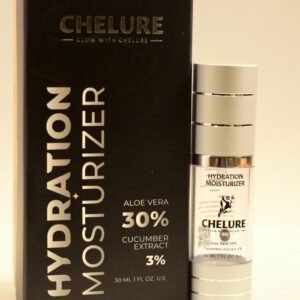
Short answer: Hyaluronic acid (HA) is a molecule that binds water. On skin, it acts as a moisturizer that helps hold water at the surface. Reviews describe benefits for skin hydration and the look of ageing, and studies are testing whether molecule size changes how well it works. Our Hydration Moisturizer contains low and high molecular-weight hyaluronic acid with 30% aloe vera juice, 3% cucumber extract, peptides and niacinamide.
Key takeaways
- HA is a humectant: it holds water, and needs a lock-in step such as a moisturizer or sunscreen.
- Size matters for where HA acts: smaller pieces may reach slightly deeper; larger ones sit on the surface and feel smoothing.
- HA suits oily, dry and dehydrated skin; it is not a treatment for any condition.
What hyaluronic acid is
HA is a long sugar chain that occurs naturally in skin, where it holds water in the layers beneath the surface. Levels fall with age and sun exposure. A 2022 review of topical hyaluronic acid (Dermatol Ther, PMID 36200921) describes HA-containing cosmeceuticals, their characteristics and their effect on signs of ageing, and notes that loss of HA begins around age 25. It also describes a randomized trial where a topical HA serum was used after botulinum toxin.
What the research says
| Source | What it covered | What it found |
|---|---|---|
| Review of topical HA, Dermatol Ther 2022 (PMID 36200921) | HA cosmeceuticals, skin ageing and exposome factors | Describes characteristics and benefits of topical HA for skin quality |
| Different molecular weights of HA in xerosis, Arch Dermatol Res 2024 (PMID 38829483) | Double-blind RCT, 36 nursing-home residents aged 60 to 80, three lotions on the legs for 4 weeks | After 4 weeks the low-molecular-weight HA area had higher skin hydration than the high-weight HA area (56.37 vs 52.37 AU) and the vehicle (49.01 AU); water loss and symptom scores did not differ; no side effects |
| Multicenter evaluation of a topical high molecular-weight HA serum, J Cosmet Dermatol 2022 (PMID 35833366) | Small multicentre study with hydration sensor, assessments and biopsies | Hydration rose at each visit versus baseline, including weeks 4 and 8; the authors have ties to the product’s maker, so treat it as industry-linked |
How to read it: the studies are small, often involve older adults or specific products, and do not test our moisturizer. We cite them to explain what HA is used for.
Why two sizes of HA
Smaller HA fragments are thought to move into the upper skin more easily, while larger ones form a light film on the surface that feels smooth and reduces water loss. Trials such as PMID 38829483 were designed to test this question, which is why we describe it as a design reason, not a proven advantage.
Why Chelure’s Hydration Moisturizer uses these ingredients
The moisturizer is a 30 mL airless-pump water gel at Rs 2,200:
- Low and high molecular-weight hyaluronic acid for water binding at different depths.
- 30% aloe vera juice and 3% cucumber extract for a cooling, soothing, water-based feel (see our aloe guide).
- Palmitoyl pentapeptide-1 and tetrapeptide-7 for the look of firmness (see our peptides guide).
- Niacinamide to support the barrier (see our niacinamide guide).
- A small amount of avocado oil for comfort. It is not oil-free.
What happens when they are combined
No trial exists of this exact formula. The reasoning: a water-based base with humectants (HA, aloe) gives hydration without a greasy finish; niacinamide supports the barrier so the water stays in; avocado oil adds a little seal. It suits oily and acne-prone skin that still gets dehydrated, especially when using acids or retinol, or in air-conditioned or humid conditions.
Price comparison
| Product | Size | Price | Per mL |
|---|---|---|---|
| Chelure Hydration Moisturizer | 30 mL | Rs 2,200 | about Rs 73 |
| Imported 2% hyaluronic acid serum | 30 mL | Rs 3,750 to Rs 5,995; most Rs 4,300 to Rs 5,450 (Pakistani online retailers, checked 3 Nov 2026) | about Rs 125 to Rs 200 |
A serum and a gel moisturizer are different products; the comparison is a rough guide to what an HA product costs. Delivery is a flat Rs 250 across Pakistan.
Does hyaluronic acid get into the skin? Molecular weight
Hyaluronic acid comes in different sizes, measured in kilodaltons (kDa). A Raman spectroscopy study of skin penetration found that low molecular weight hyaluronic acid (20 to 300 kDa) passed through the outer skin layer, while high molecular weight hyaluronic acid (1,000 to 1,400 kDa) did not (PMID 25877232). A review of hyaluronic acid in cosmetics agrees that molecular weight influences both penetration and biological activity (PMID 34361586). In the 2024 trial of 36 older adults, a lotion with low molecular weight hyaluronic acid gave higher skin hydration after four weeks than a high molecular weight lotion or a plain base, while water loss and symptom scores did not differ (PMID 38829483).
The practical reading is that smaller pieces can reach slightly deeper while larger pieces form a light, hydrating film on the surface, which is why our moisturizer uses both. Topical hyaluronic acid is a moisturizing ingredient, not a substitute for injected fillers, and it does not rebuild skin structure.
Humectants, humidity and water activity
Hyaluronic acid is a humectant, an ingredient that holds water. A double-blind study of healthy volunteers found that a small change in the water activity of a topical formulation was enough to change stratum corneum hydration and permeability considerably, that humectants such as glycerol and urea promoted hydration even at reduced water activity, and that ambient humidity affects the skin barrier (PMID 24786192). For Karachi, this means a water-based gel is usually comfortable in humid months, while air-conditioned rooms and winter air pull water out of skin and call for a sealing layer. Our guides to air conditioning and dehydrated skin and dehydrated versus dry skin go into that.
Where it fits in a routine
- After cleansing and after any active serum, apply the gel to slightly damp skin so there is water for it to bind.
- Follow with sunscreen in the morning. In the evening, add a richer cream on top if your skin feels tight in air-conditioning.
- One pump of a gel moisturizer is enough for the face. More does not hydrate more.
- If you use retinol or exfoliating acids, a hydrating gel is a gentle way to reduce dryness. See our guide to the order of a routine.
What hyaluronic acid does not do
It does not treat acne, remove pigment or change skin colour. It does not replace sunscreen. If your dryness comes with itching, a rash or cracking that does not settle, that is a skin barrier or eczema issue for a doctor, not a hydration gap that more serum will fix.
Reading the label: hyaluronic acid and sodium hyaluronate
- Sodium hyaluronate is the salt form of hyaluronic acid and is commonly used in cosmetics. They belong to the same family of ingredients.
- Labels that mention low and high molecular weight, or hydrolysed hyaluronic acid, are describing different sizes. Our moisturizer lists low and high molecular weight hyaluronic acid.
- A serum and a gel moisturizer do different jobs. A gel moisturizer combines the water-binding step with a moisturizing base, which is how we use it.
Common mistakes with hyaluronic acid
- Applying it to dry skin in dry air without sealing it in. Water can then leave skin again.
- Layering many humectant products. More layers do not mean more hydration.
- Expecting wrinkles to fill. Topical hyaluronic acid is not an injectable filler.
- Treating persistent dryness with more serum when the real problem is a damaged barrier (see our barrier guide).
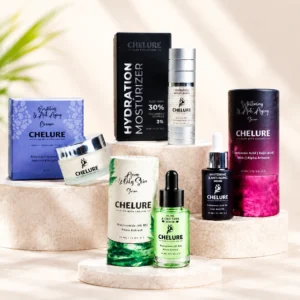
Complete Range: All 4 Chelure Products
How to use it
Morning and night; after serums and before sunscreen; one pump is enough; works under makeup.
Who should speak to a doctor first
Persistent dryness, itching or rash that does not settle; eczema; reaction to any ingredient on the label.
Frequently asked questions
What does hyaluronic acid do for skin?
Hyaluronic acid binds water. On skin it works as a moisturizing ingredient that helps hold water at the surface, and reviews describe benefits for skin hydration and the look of ageing. It needs a moisturizer or sunscreen over it to keep the water in.
Is hyaluronic acid good for oily skin?
Yes. Oily skin can still be dehydrated, and a water-based gel with hyaluronic acid adds water without a greasy film. Ours contains a small amount of avocado oil, so it is not oil-free. People using acne acids often find a light gel more comfortable than a heavy cream.
Can hyaluronic acid dry skin out?
In very dry air, a humectant without a sealing step can feel drying, because water can leave the skin again. Apply it to slightly damp skin and follow with moisturizer or sunscreen. On very dry days, add a sealing layer over our light gel.
Low vs high molecular-weight HA: what is the difference?
Smaller pieces are thought to reach slightly deeper, while larger pieces sit on the surface. A 2024 trial in 36 older adults found the low-molecular-weight lotion gave higher skin hydration after 4 weeks than the high-weight lotion or the vehicle. Our gel contains both sizes.
Should I apply hyaluronic acid to damp skin?
Applying to slightly damp skin gives hyaluronic acid more water to bind. Then seal with moisturizer or sunscreen. One pump of our gel is enough for the face.
Can I use hyaluronic acid with retinol or acids?
Yes. Hyaluronic acid is gentle and suits routines with retinol or exfoliating acids, which can dry skin. Apply the actives first, then the gel, and use sunscreen every morning. See a doctor if any product causes persistent redness or rash.
Sources
- Bravo B et al. Benefits of topical hyaluronic acid for skin quality and signs of skin aging: From literature review to clinical evidence. Dermatol Ther, 2022. PubMed 36200921
- Muhammad P et al. Effectiveness of topical hyaluronic acid of different molecular weights in xerosis cutis treatment in elderly: a double-blind, randomized controlled trial. Arch Dermatol Res, 2024. PubMed 38829483
- Robinson DM et al. Multicenter evaluation of a topical hyaluronic acid serum. J Cosmet Dermatol, 2022. PubMed 35833366
- Essendoubi M et al. Human skin penetration of hyaluronic acid of different molecular weights as probed by Raman spectroscopy. Skin Res Technol, 2016. PubMed 25877232
- Juncan AM et al. Advantages of Hyaluronic Acid and Its Combination with Other Bioactive Ingredients in Cosmeceuticals. Molecules, 2021. PubMed 34361586
- Albèr C et al. Effects of water activity and low molecular weight humectants on skin permeability and hydration dynamics – a double-blind, randomized and controlled study. Int J Cosmet Sci, 2014. PubMed 24786192
Related guides
- Moisturizer for Dry Skin in Pakistan: How to Choose
- Dehydrated Skin vs Dry Skin: Signs and What Helps
- Damaged Skin Barrier: Signs, Causes and How It Repairs
- Oil-Free Lotion vs Water-Gel Moisturizer in Pakistan
- Air Conditioning and Dehydrated Skin: Why Skin Feels Tight Indoors in Karachi
- Moisturizer for Oily Skin in Pakistan: Why You Still Need One
More ingredient guides
This page is general information, not medical advice. See how we write and source our guides.