
Alpha Arbutin in Pakistan: What It Does and Our Serum

Brightening & Anti-Aging Serum
Short answer: Alpha arbutin is a plant-derived ingredient that slows the enzyme your skin uses to make pigment. It is a popular cosmetic brightening ingredient. Laboratory studies are consistent; human trials are smaller, and a 2021 review calls for larger studies. Our Brightening & Anti-Aging Serum combines alpha arbutin with 3% tranexamic acid, 3% kojic acid and AHAs in 30 mL for Rs 2,500.
Key takeaways
- Alpha arbutin works on the same enzyme as kojic acid, by a different route; it does not remove existing pigment instantly.
- Results take weeks, and sun exposure can undo them.
- Dark marks after acne often fade on their own with sunscreen; a serum may help the look of them over time.
- A doctor should check dark patches that are sudden, uneven or spreading.
What alpha arbutin is
Arbutin is a compound found in plants such as bearberry. It comes in two forms, alpha and beta. Alpha arbutin is made in a lab by linking glucose to hydroquinone in a stable way. In skin, it competes with tyrosine, the raw material, at the enzyme tyrosinase, which controls the first steps of melanin production. A 2021 review of its therapeutic potential (Phytother Res, PMID 33724594) reports that in laboratory comparisons alpha arbutin inhibits tyrosinase more strongly than the beta form, and it states that high-quality trials in larger groups are still needed to confirm clinical effects. An earlier survey of skin-lightening agents and their mechanisms (Phytother Res 2006, PMID 16841367) describes arbutin among the ingredients that act on tyrosinase.
What it can and cannot do
- It is used for the look of uneven tone, sun spots and the brown marks left after acne (post-inflammatory hyperpigmentation, reviewed in J Clin Aesthet Dermatol 2010, PMID 20725554). That review notes that sun protection is a basic part of managing pigmentation.
- It does not change your natural skin colour and is not designed to.
- It does not replace prescription treatments that a skin doctor may suggest for conditions like melasma (see the evidence-based melasma review, PMID 31802394).
Alpha arbutin and hydroquinone
People often ask whether alpha arbutin is the same as hydroquinone. They are related chemically, and hydroquinone is the active used in many prescription lighteners. Alpha arbutin is a bound, gentler-acting form and is sold in cosmetics, while hydroquinone products are regulated medicines in many countries. We do not make comparisons of strength or safety beyond this; ask a skin doctor about which suits you. The European consumer-safety committee (SCCS) set a maximum of 2% alpha arbutin in face creams (PMID 26646661, confirmed in its later opinion), and asks that hydroquinone traces be kept as low as possible. We searched for a Pakistan regulator notice on arbutin on 3 November 2026 and did not find one.
Why Chelure’s Brightening & Anti-Aging Serum uses alpha arbutin with the other ingredients
- Alpha arbutin slows tyrosinase by competing with its raw material.
- 3% kojic acid binds the copper that tyrosinase needs, a different way of slowing the same enzyme.
- 3% tranexamic acid is studied for the signals that switch pigment production on after UV and inflammation (see our tranexamic acid guide).
- AHAs (glycolic, lactic) loosen dull surface cells so the other ingredients spread more evenly (PMID 21437068).
- Glycerin and sodium PCA hold water during exfoliation; licorice, bearberry, allantoin and vitamin E soothe.
What happens when they are combined
There is no published trial of this exact combination. The logic is to cover several steps of pigment production at once: the signal (tranexamic acid), the enzyme (alpha arbutin and kojic acid) and the surface (AHAs). The trade-off is a greater chance of irritation, which is why the formula has soothing ingredients and why we say to build up slowly and wear sunscreen daily.
Price comparison
| Product | Size | Price | Per mL |
|---|---|---|---|
| Chelure Brightening & Anti-Aging Serum (alpha arbutin + 3% TXA + 3% kojic acid + AHAs) | 30 mL | Rs 2,500 | about Rs 83 |
| Imported alpha arbutin serums | 30 mL | Rs 2,600 to Rs 7,700; most Rs 3,500 to Rs 5,900 (Pakistani online retailers, checked 3 Nov 2026) | about Rs 117 to Rs 197 |
Delivery is a flat Rs 250 across Pakistan. The alpha arbutin percentage is not printed on our product page, so we do not state one here.
What trials of arbutin-based creams report
A 2025 split-face randomized study in 30 people with melasma compared a cream with 5% alpha arbutin and 2% kojic acid with a triple combination cream (the standard hydroquinone-based regimen) for 12 weeks, with a further 4 weeks of follow-up (PMID 39555866). The two sides did not differ significantly in the modified melasma score or the melanin index. A physician global score improved only on the triple-cream side, but the triple-cream side also showed more recurrence after treatment stopped and more redness and stinging. The authors concluded that the arbutin and kojic acid cream appeared effective, with a lower recurrence rate and fewer adverse events.
Treat this as one small trial, not a verdict. It used 5% alpha arbutin, we do not print an alpha arbutin percentage for our serum, and it involved people with melasma. A 2019 systematic review of 35 topical melasma trials included arbutin among many agents, but its strong recommendations went to cysteamine, triple combination therapy and tranexamic acid, and it said natural compounds need more research on effectiveness, formulation and concentration (PMID 31741361). A fair summary is that alpha arbutin is promising and widely used, not proven to the same standard.
Alpha and beta arbutin: why the form matters
Arbutin comes in two forms, alpha and beta. The 2021 review we cite reports laboratory comparisons in which alpha arbutin inhibits tyrosinase more strongly than the beta form (PMID 33724594), which is why cosmetic serums tend to use the alpha form. Laboratory strength does not translate one-to-one into skin results, because what matters in practice is how much reaches the skin, in what formula, and how often it is used.
Brown marks, red marks and what a serum can reach
Dark marks left after a pimple are post-inflammatory hyperpigmentation. A review of the condition notes that sun protection is a basic part of management and that these marks often fade slowly over months (PMID 20725554). Pink or red marks are a different problem, linked to blood vessels in the healing skin rather than to pigment, so a pigment-focused ingredient is not aimed at them. Our guide to red marks versus brown marks shows how to tell them apart, and how to fade dark marks after acne covers what helps each.
A realistic routine around a brightening serum
- Morning: gentle cleanser, moisturizer, then a broad-spectrum sunscreen. Reapply if you are outdoors for long.
- Evening: after cleansing, use the serum on alternate nights for the first two weeks, then nightly if your skin stays comfortable, followed by moisturizer.
- At first, avoid using another exfoliating acid or retinol on the same night. Add one change at a time so you can tell what is helping and what is irritating.
- Patch-test behind the ear or on the jaw for a few days before applying to the whole face.
Reading the label: alpha arbutin, arbutin and bearberry
- Look for the exact name alpha-arbutin. A product that only says arbutin may contain the beta form, which the review we cite reports as weaker in laboratory tests.
- Bearberry extract naturally contains arbutin. Our serum lists both alpha arbutin and bearberry extract, so the second is there partly for its plant arbutin and partly as a soothing botanical.
- A percentage is useful when printed, and a missing percentage is a reason to ask the brand. We do not print one for alpha arbutin, which is why this page does not compare strengths.
Common mistakes with brightening serums
- Judging results after a week. Skin renews over weeks, and trials of pigment treatments run for 8 to 12 weeks or longer.
- Skipping sunscreen on cloudy days. UV and visible light still reach skin, and pigment responds to both.
- Using several brightening products at once, then not knowing which one caused irritation.
- Treating every dark patch the same way. Patches that are sudden, uneven or spreading need a doctor, and melasma needs a diagnosis first (see our melasma guide).
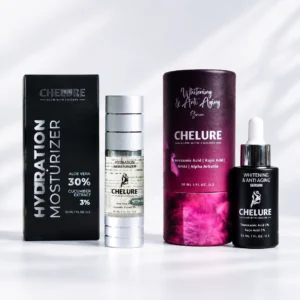
Set C: Brightening Serum + Hydration Moisturizer
How to use it
Start with a few drops every second evening; moisturizer after; sunscreen every morning; patch-test; stop if skin burns, swells or peels badly.
Who should speak to a doctor first
Pregnancy or breastfeeding, active eczema or open skin, a history of reaction to AHAs or kojic acid, or patches that are sudden, uneven or spreading.
Frequently asked questions
What does alpha arbutin do for skin?
Alpha arbutin slows tyrosinase, the enzyme that starts melanin production, by competing with its raw material. It is used for the look of uneven tone, sun spots and post-acne marks. It does not change natural skin colour, and a 2021 review says larger human trials are still needed.
Is alpha arbutin safe?
The European consumer-safety committee set a maximum of 2% alpha arbutin in face creams and asks that hydroquinone traces be kept as low as possible. Patch-test any new product and stop if your skin burns or swells. If you are unsure, ask a skin doctor.
Alpha arbutin vs hydroquinone: what is the difference?
They are related chemically. Hydroquinone is used in many prescription lighteners and is regulated as a medicine in many countries. Alpha arbutin is a bound form sold in cosmetics. We do not compare their strength or safety beyond this, so ask a skin doctor which suits you.
How long does alpha arbutin take to work?
Skin renews over weeks, so most people judge a brightening serum after 4 to 12 weeks of regular use with sunscreen every morning. Results vary, and sun exposure can undo them. Evidence for alpha arbutin in people comes from fairly small studies.
Can I use alpha arbutin with other actives?
Alpha arbutin is usually used alongside other brightening ingredients, and our serum combines it with tranexamic acid, kojic acid and AHAs. Retinol and acids can irritate, so introduce one change at a time, moisturize, and wear sunscreen every morning.
Does alpha arbutin work for post-acne marks?
Brown marks left after acne are post-inflammatory hyperpigmentation, and they often fade slowly on their own, faster with sun protection. Alpha arbutin is used to support the look of fading. Red marks are different and respond differently, so check which type you have first.
Sources
- Saeedi M et al. A comprehensive review of the therapeutic potential of α-arbutin. Phytother Res, 2021. PubMed 33724594
- Parvez S et al. Survey and mechanism of skin depigmenting and lightening agents. Phytother Res, 2006. PubMed 16841367
- Davis EC et al. Postinflammatory hyperpigmentation: a review of the epidemiology, clinical features, and treatment options in skin of color. J Clin Aesthet Dermatol, 2010. PubMed 20725554
- McKesey J et al. Melasma Treatment: An Evidence-Based Review. Am J Clin Dermatol, 2020. PubMed 31802394
- Kornhauser A et al. Applications of hydroxy acids: classification, mechanisms, and photoactivity. Clin Cosmet Investig Dermatol, 2010. PubMed 21437068
- Sccs et al. Opinion of the Scientific Committee on Consumer safety (SCCS)–Opinion on the safety of the use of α-arbutin in cosmetic products. Regul Toxicol Pharmacol, 2016. PubMed 26646661
- Tantanasrigul P et al. The Efficacy of Topical Cosmetic Containing Alpha-Arbutin 5% and Kojic Acid 2% Compared With Triple Combination Cream for the Treatment of Melasma: A Split-Face, Evaluator-Blinded Randomized Pilot Study. J Cosmet Dermatol, 2025. PubMed 39555866
- Austin E et al. Topical Treatments for Melasma: A Systematic Review of Randomized Controlled Trials. J Drugs Dermatol, 2019. PubMed 31741361
Related guides
- Alpha Arbutin Serum in Pakistan: Price, Benefits and vs Kojic Acid
- How to Choose a Serum for Dark Spots in Pakistan
- Pimple Marks Removal: Cream vs Serum vs Home Remedies in Pakistan
- Red Marks vs Brown Marks After Acne: PIE and PIH Explained
- Pigmentation on the Face in Pakistan: Types, Causes and What Each Needs
More ingredient guides
This page is general information, not medical advice. See how we write and source our guides.