
Glutathione Cream in Pakistan: Price, Research and Our Night Cream

Brightness & Anti-Aging Night Cream
Short answer: Glutathione is an antioxidant that your body already makes, and it is sold as a cream, serum, tablet and injection for skin brightening. Published reviews call the evidence for creams and tablets limited and inconsistent, and the safety data for injections thin. Chelure’s Brightness & Anti-Aging Night Cream lists 2% glutathione with 3% oil-soluble kojic acid, encapsulated retinol and 3% palmitoyl pentapeptide-4, in a 50 mL jar for Rs 2,999.
Key takeaways
- Skin colour is mostly genetic. No glutathione product changes it permanently, and none replaces daily sunscreen.
- Reviews find modest, short-lived effects for topical and oral forms, and call the injection evidence inadequate.
- A single injection in Karachi is listed at about Rs 3,000 to Rs 25,000 depending on the clinic, and clinics sell courses of several sessions. A jar of our night cream costs Rs 2,999. They are different products with different risks, not interchangeable.
- Our cream lists every active percentage on its page. We describe what each ingredient is studied for; there is no trial of our exact formula.
What glutathione is, and why it is linked to skin tone
Glutathione is a small molecule made of three amino acids: glutamate, cysteine and glycine. Almost every cell in the body makes it. Its main job is to act as an antioxidant, helping cells deal with oxidative stress, and to support detoxifying enzymes in the liver. Your body keeps its own supply; taking more by mouth, cream or injection does not mean more reaches the skin.
The link to skin colour comes from laboratory work on melanin, the pigment that gives skin, hair and eyes colour. Melanin is made in a step-by-step chain driven by the enzyme tyrosinase. A review of how glutathione behaves in this chain (Villarama and Maibach, Int J Cosmet Sci 2005, PMID 18492181) describes three ways it may matter: it can interfere with tyrosinase, it can shift pigment production toward a lighter type of melanin (pheomelanin instead of eumelanin), and it acts as an antioxidant that limits oxidative triggers of pigmentation. These are laboratory and mechanism findings. They explain why glutathione is studied. They do not prove that a cream changes the tone of living skin.
What cosmetic brightening can realistically mean: reducing the look of dark spots and dullness caused by sun, acne marks and uneven tone, over weeks, with daily sunscreen. A review of post-acne dark marks in skin of colour (Davis and Callender, J Clin Aesthet Dermatol 2010, PMID 20725554) notes that sun protection is a basic part of managing pigmentation, because UV and visible light keep triggering it.
What the research says, form by form
| Form | What reviews report | Main concern |
|---|---|---|
| Cream or serum | Small trials report modest, local effects on a melanin-index measure | Small studies; effects not sustained |
| Tablets or capsules | Several small trials versus placebo report reductions in melanin index | Limited absorption; some adverse events |
| Injection or drip | Only one placebo-controlled study, no clear benefit | Safety data inadequate; regulators have warned |
Sources: systematic review, Int J Dermatol 2025 (PMID 39444151); Dilokthornsakul et al. 2019 (PMID 30895708); Sonthalia et al., Indian J Dermatol Venereol Leprol 2016 (PMID 27088927); critical review of all routes, J Med Life 2026 (PMID 42751591). We read these for what they say about quality of evidence: most trials are small and short, so conclusions are cautious.
Injections and drips: what the sources say, and what they cost
An injection puts glutathione directly into the bloodstream or skin. That is a medical procedure. The evidence base for using it to lighten skin is weak. A 2016 paper in the South African Medical Journal is titled “Intravenous glutathione for skin lightening: Inadequate safety data” (PMID 27499402). The Indian review above (PMID 27088927) notes that adverse effects led the Philippines Food and Drug Administration to warn against off-label use. A systematic review of glutathione as a skin-lightening agent (Int J Dermatol 2025, PMID 39444151) found only one placebo-controlled study of intravenous glutathione (6 of 16 people improved versus 3, a difference that did not reach statistical significance) and concludes that “IV glutathione is contraindicated due to lack of efficacy and side effects.” In 2019 the Philippines Food and Drug Administration (Advisory No. 2019-182) stated that no injectable product is approved for skin lightening and that injectable glutathione is approved only as an adjunct in certain chemotherapy; news reports of the advisory describe concerns about the liver, kidneys and nervous system. We searched for a notice from Pakistan’s drug regulator specifically about glutathione injections on 3 November 2026 and did not find one.
What it costs in Karachi (price range, not a recommendation):
| Item | Typical range | Source |
|---|---|---|
| Single injection or drip, public clinic price lists | Rs 3,000 to Rs 25,000 per session; most quotes about Rs 8,000 to Rs 15,000 | Clinic and directory price pages reviewed 3 Nov 2026 (log kept) |
| A course of 6 to 8 sessions | One public listing quoted Rs 80,000 to Rs 120,000 | Clinic price page reviewed 3 Nov 2026 |
Prices vary by clinic, brand, dose and added vitamin C, and online quotes come from clinics that sell the treatment, so they are marketing figures. Please confirm directly. Anything involving injections is a decision for a licensed doctor; we are not telling anyone to stop or avoid a treatment, and our cream is not an alternative to medical care.
Why Chelure’s Night Cream uses these ingredients
The Brightness & Anti-Aging Night Cream is a 50 mL jar at Rs 2,999. Here is each ingredient, what it is, what research says about it, and why it is in the formula.
Glutathione (2%). The antioxidant described in section 1. Reviews find modest effects for topical use in small trials, with a concentration range of roughly 0.5% to 2% studied. We list it at 2% on the product page. It is in the formula as one of two ingredients aimed at the pigment pathway, and as an antioxidant in an anti-aging cream. We make no promise of a change in colour.
Kojic acid (3%, oil-soluble). Kojic acid is a compound made by fungi that binds copper, which tyrosinase needs to work. Reviews of tyrosinase inhibitors (Chang, Int J Mol Sci 2009, PMID 19582213) describe it as one of the most studied lighteners in cosmetic use. It is oil-soluble here, which suits a cream. Why 3%: it sits within the range used in studied brightening products; it can irritate or cause contact reactions in some people, which is why we say to start slowly. It is paired with glutathione because the two act on the same chain at different points, not because we have shown one boosts the other.
Encapsulated retinol (liposome). Retinol is a form of vitamin A. A controlled study of retinol on naturally aged skin (Kafi et al., Arch Dermatol 2007, PMID 17515510) and a clinical review of retinoids in skin aging (Mukherjee et al., Clin Interv Aging 2006, PMID 18046911) support its use for the look of fine lines and texture, with irritation (dryness, peeling) as the main downside. Encapsulating retinol in liposomes is designed to deliver it more gently; we describe this as design intent, not as a proven advantage. It is in the formula because anti-aging and brightening concerns often come together after sun exposure.
3% palmitoyl pentapeptide-4. A short chain of five amino acids studied for the look of wrinkles. A published study of a topical palmitoyl pentapeptide on photoaged facial skin (Robinson et al., Int J Cosmet Sci 2005, PMID 18492182) and a 2023 double-blind trial for crow’s feet (J Clin Aesthet Dermatol, PMID 36909866) report improvements in the look of lines. Evidence is cosmetic-grade and trial sizes are small. It supports the look of firmness and has no pigment action.
Squalane, jojoba and avocado oil. Plant oils and squalane cushion the skin and slow water loss, which matters because retinol and kojic acid can dry or irritate. A review of plant oils and the skin barrier (Lee et al., Int J Mol Sci 2017, PMID 29280987) reports barrier benefits for several oils, though results differ by oil. Some oils can clog pores in acne-prone people; this cream suits normal to dry skin best.
Licorice, bearberry, allantoin and vitamin E. Soothing and antioxidant ingredients. Licorice and bearberry are traditionally used in brightening products. Allantoin and vitamin E are common comfort ingredients. They are in the formula to help balance the more active ingredients.
What happens when these ingredients are combined
Honest answer first: there is no published trial of this exact combination. What we can explain is the reasoning.
- Two ingredients on one pathway, at different points. Kojic acid works on tyrosinase’s copper; glutathione is studied for its effect on the pigment type and on oxidative stress. They are chosen to target different steps of the same process.
- Renewal plus cushioning. Retinol speeds up how skin renews itself. Faster renewal can bring irritation, so the oils, squalane and soothing extracts are there to make the cream tolerable at night.
- Why one jar can matter for the routine. Using several single-ingredient bottles costs more and adds steps, but a combined formula also means you cannot adjust one ingredient on its own. Retinol and kojic acid together are more likely to irritate, so we say to start two to three nights a week.
- What combining does not do. It does not make a cream act like a medical treatment, and it does not remove the need for sunscreen every morning.
Price per mL and what you get
| Product | Size | Price | Per mL |
|---|---|---|---|
| Chelure Brightness & Anti-Aging Night Cream | 50 mL | Rs 2,999 | about Rs 60 |
| Glutathione whitening creams sold in Pakistan (mostly day or general creams, 40 to 50 g) | about 40 to 50 g | Rs 650 to Rs 2,250 (Pakistani online retailers, checked 3 Nov 2026) | about Rs 15 to Rs 55 per g |
Our night cream costs more than most mass-market glutathione creams. The difference is in what the label tells you: we print every active percentage, and the formula adds encapsulated retinol, a peptide and kojic acid. Cheaper creams may not list strengths, so compare the label, not only the price. Delivery is a flat Rs 250 across Pakistan.
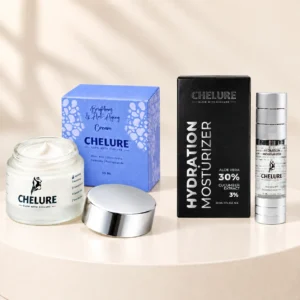
Set B: Night Cream + Hydration Moisturizer
How to use it
Night only, pea-sized, on clean dry skin; start two to three nights a week and build up as your skin allows; sunscreen every morning; patch-test first; stop if skin burns, blisters or swells.
Who should speak to a doctor first
Pregnancy or breastfeeding, active eczema or open skin, a history of reaction to retinoids or kojic acid, or any sudden, uneven or spreading darkening of the skin.
Frequently asked questions
Does glutathione cream really lighten skin?
Reviews describe modest, local effects from topical glutathione in small trials, and the effects are not sustained. Skin colour is mostly genetic and no cream changes it permanently. Our night cream lists 2% glutathione with kojic acid, but we make no promise of a change in colour.
How long does a glutathione cream take to show results?
Skin renews over weeks, so most people judge a brightening cream after 4 to 12 weeks of regular use with sunscreen every morning. We cannot promise a result. If nothing changes after that, a skin doctor can look at the cause of the pigmentation.
Glutathione cream vs tablets: which has more evidence?
A 2025 review found several small placebo-controlled trials of oral glutathione that reduced a melanin measure, and small trials of topical forms. Both are described as moderately effective but not sustained, with tablets carrying more side effects. Neither is proven better. Ask a doctor before taking tablets.
Is glutathione injection safe?
The 2025 systematic review we cite found only one placebo-controlled study of intravenous glutathione and concluded it is contraindicated because of lack of efficacy and side effects. The Philippines FDA has also warned against it for skin lightening. Any injection should only be considered with a licensed doctor.
How much does a glutathione injection cost in Karachi?
Public clinic price lists we reviewed on 3 November 2026 showed about Rs 3,000 to Rs 25,000 per session, with most quotes around Rs 8,000 to Rs 15,000. One listing quoted Rs 80,000 to Rs 120,000 for 6 to 8 sessions. Prices vary by clinic and are sellers’ own figures.
Can I use glutathione cream with retinol?
Both are often used in one routine, and our night cream already combines glutathione with encapsulated retinol and kojic acid. Retinol and kojic acid can both irritate, so start 2 to 3 nights a week, use sunscreen every morning, and stop if skin burns or swells.
Is glutathione cream safe in pregnancy?
We found no pregnancy safety data for topical glutathione in the research we reviewed, so we cannot say it is safe. Our night cream also contains retinol, which is generally avoided in pregnancy. If you are pregnant, breastfeeding or trying to conceive, ask your doctor first.
Do I need sunscreen with a brightening cream?
Yes. Sun exposure keeps triggering pigment, and reviews of pigmentation list sun protection as a basic part of management. A brightening cream does not replace it. Use a broad-spectrum sunscreen every morning and reapply when you are outdoors.
Sources
- Villarama CD et al. Glutathione as a depigmenting agent: an overview. Int J Cosmet Sci, 2005. PubMed 18492181
- Chang TS et al. An updated review of tyrosinase inhibitors. Int J Mol Sci, 2009. PubMed 19582213
- Davis EC et al. Postinflammatory hyperpigmentation: a review of the epidemiology, clinical features, and treatment options in skin of color. J Clin Aesthet Dermatol, 2010. PubMed 20725554
- Kafi R et al. Improvement of naturally aged skin with vitamin A (retinol). Arch Dermatol, 2007. PubMed 17515510
- Mukherjee S et al. Retinoids in the treatment of skin aging: an overview of clinical efficacy and safety. Clin Interv Aging, 2006. PubMed 18046911
- Robinson LR et al. Topical palmitoyl pentapeptide provides improvement in photoaged human facial skin. Int J Cosmet Sci, 2005. PubMed 18492182
- Aruan RR et al. Double-blind, Randomized Trial on the Effectiveness of Acetylhexapeptide-3 Cream and Palmitoyl Pentapeptide-4 Cream for Crow’s Feet. J Clin Aesthet Dermatol, 2023. PubMed 36909866
- Lin TK et al. Anti-Inflammatory and Skin Barrier Repair Effects of Topical Application of Some Plant Oils. Int J Mol Sci, 2017. PubMed 29280987
- Sarkar R et al. Glutathione as a skin-lightening agent and in melasma: a systematic review. Int J Dermatol, 2025. PubMed 39444151
- Dilokthornsakul W et al. The clinical effect of glutathione on skin color and other related skin conditions: A systematic review. J Cosmet Dermatol, 2019. PubMed 30895708
- Sonthalia S et al. Glutathione as a skin whitening agent: Facts, myths, evidence and controversies. Indian J Dermatol Venereol Leprol, 2016. PubMed 27088927
- Davids LM et al. Intravenous glutathione for skin lightening: Inadequate safety data. S Afr Med J, 2016. PubMed 27499402
- Aloraini K et al. Glutathione for skin lightening via intravenous, oral, and topical routes: a critical narrative review of current evidence, safety, and the evidence-practice gap. J Med Life, 2026. PubMed 42751591
Related guides
- Glutathione for Skin: Cream, Serum, Tablets and Injections Compared
- Kojic Acid Soap, Cream or Serum: Which Form to Choose in Pakistan
- How to Choose a Serum for Dark Spots in Pakistan
- Skincare Routine Order in Pakistan: Morning and Night, Step by Step
- Why Pakistani Skin Gets Dark Spots, and What Actually Helps
More ingredient guides
This page is general information, not medical advice. See how we write and source our guides.