
Tranexamic Acid in Pakistan: Research, Products and Our Serum

Brightening & Anti-Aging Serum
Short answer: Tranexamic acid is a compound first made as a medicine to reduce bleeding. Doctors also use it, off-label, for melasma and stubborn dark spots. Reviews of trials report lower pigmentation scores, mostly in studies of oral and clinic-given treatment, and the evidence for cosmetic creams and serums is smaller. Our Brightening & Anti-Aging Serum lists 3% tranexamic acid with 3% kojic acid, alpha arbutin and AHAs in a 30 mL bottle for Rs 2,500.
Key takeaways
- Tranexamic acid is not a bleaching agent. It is studied for how it affects the signals that trigger pigment production after sun and inflammation.
- The strongest data are for melasma treated by doctors; a cosmetic serum is not a medical treatment and is not studied as one.
- Tablets are a prescription medicine with real risks (blood clots). Do not take them for your skin without a doctor.
- Sunscreen every morning matters more than any serum for dark spots.
What tranexamic acid is
Tranexamic acid (TXA) is a synthetic form of the amino acid lysine. It was developed to reduce bleeding by blocking plasmin, an enzyme that breaks down blood clots. Researchers noticed that people taking it for other reasons sometimes saw melasma fade, and that led to trials in pigmentation. Plasmin is also active in skin after UV exposure, where it is part of the chain of signals that tells pigment cells to make more melanin. The idea behind TXA for skin is that blocking plasmin may quiet that signal. This is a proposed mechanism, and reviews describe it as not fully settled.
What the research says
| Source | What it covered | What it found |
|---|---|---|
| Meta-analysis and systematic review of RCTs, J Dermatolog Treat 2024 (PMID 38843906) | 22 studies, 1,280 patients; TXA given orally, topically or by injection | Reductions in melasma severity scores. Oral TXA showed the largest decrease, followed by injections, then topical use; the studies varied a lot. Side effects included stomach discomfort, skin irritation and menstrual changes |
| Systematic review, Acta Derm Venereol 2017 (PMID 28374042) | 11 studies, 667 participants, mostly oral TXA | Average MASI score fell by 1.6 points; side effects reported as minor, such as mild abdominal discomfort and transient skin irritation |
| Focused review of administration routes, J Cosmet Dermatol 2023 (PMID 36606378) | 46 articles on oral, intralesional and topical TXA | Describes all three routes as effective in studies, and notes melasma is often hard to treat |
| Systematic review of topical and systemic melasma therapies, Indian Dermatol Online J 2023 (PMID 38099013) | Melasma treatments compared | Places TXA among several options alongside sun protection |
How to read this: the trials mainly involve melasma (a specific condition diagnosed by a doctor), often use oral tablets or in-clinic methods, and vary in dose and length from 8 weeks to nearly 2 years. A cosmetic serum for general dark spots and post-acne marks is a different situation. We cite the research to explain why the ingredient is used, not to claim our serum treats melasma.
Tablets, injections and creams: why the route matters
Oral tranexamic acid is a prescription drug. It affects blood clotting throughout the body, so doctors screen for clot history, hormone use and other risks before prescribing it. Topical and in-clinic routes keep the dose in the skin, which is why reviews list them separately. If you have melasma, a skin doctor can tell you which route, if any, suits you.
Why Chelure’s Brightening & Anti-Aging Serum uses these ingredients
The serum is a 30 mL dropper bottle at Rs 2,500. It lists:
- 3% tranexamic acid. The plasmin-blocking ingredient above. It is in the formula as the main “signal” ingredient for dark spots and uneven tone.
- 3% kojic acid. A fungal-derived compound that binds copper, which the pigment enzyme tyrosinase needs. It acts further along the pigment chain than TXA. It can irritate some people.
- Alpha arbutin. A glucose-linked form of a plant compound that also slows tyrosinase. Reviews describe lab evidence and call for larger human trials (PMID 33724594).
- AHAs (glycolic and lactic acid). They loosen dull surface cells so the other ingredients reach the skin more evenly and skin looks smoother. They also make skin more sun-sensitive, so sunscreen is not optional (PMID 21437068).
- Glycerin and sodium PCA to hold water while AHAs exfoliate.
- Licorice extract, bearberry extract, allantoin and vitamin E to soothe and protect the barrier.
What happens when they are combined
There is no published trial of this exact formula. The reasoning is this: pigment is made in steps, so a formula can include ingredients that act at different points: a signal-quieting ingredient (TXA), enzyme-slowing ingredients (kojic acid, alpha arbutin) and a surface-renewing step (AHAs). The risk of stacking is irritation, which is why the soothing and water-holding ingredients are in the same bottle, and why we say to start every second night and use sunscreen. Combining ingredients does not make the product a medical treatment.
Price comparison
| Product | Size | Price | Per mL |
|---|---|---|---|
| Chelure Brightening & Anti-Aging Serum (3% TXA, 3% kojic acid, alpha arbutin, AHAs) | 30 mL | Rs 2,500 | about Rs 83 |
| Imported niacinamide-and-tranexamic-acid serum (sold in Pakistan with 4% tranexamic acid) | 30 mL | Rs 5,100 to Rs 7,700 at most retailers; a few listings lower or higher (checked 3 Nov 2026) | about Rs 170 to Rs 257 |
| Imported alpha arbutin serums | 30 mL | Rs 2,600 to Rs 7,700; most Rs 3,500 to Rs 5,900 (checked 3 Nov 2026) | about Rs 117 to Rs 197 |
Our serum has 3% tranexamic acid; the imported serum above has 4%. The comparison is on price and on how many pigment ingredients share one bottle, not on equal strength. Delivery is a flat Rs 250 across Pakistan.
Topical tranexamic acid compared with hydroquinone
A 2024 double-blind, split-face trial in 20 people with melasma compared a 3% tranexamic acid cream with a 4% hydroquinone cream for 8 weeks (PMID 38918942). Both sides showed a significant fall in the modified melasma score at weeks 4 and 8, and patient-rated improvement did not differ significantly between the two creams. The authors describe the 3% tranexamic acid cream as as effective and safe as 4% hydroquinone in their Indonesian study group, with possible advantages in side effects. It is a small, short study in one population, and it was done in people with melasma, so it does not show that a cosmetic serum treats melasma.
Where topical tranexamic acid sits among melasma treatments
A 2021 network meta-analysis pooled 59 randomized trials and compared 14 melasma therapies (PMID 34660626). In its efficacy ranking, laser and light treatments came first, followed by a triple combination cream, topical vitamin C, oral tranexamic acid and peels, with topical tranexamic acid ranked below those and above tretinoin and hydroquinone. Weighing efficacy and side effects together, the authors named the triple combination cream the most favourable topical choice. In that analysis the share of people reporting side effects was higher for topical tranexamic acid (about 37%) than for hydroquinone (about 18%).
A 2019 systematic review of 35 randomized trials of topical melasma treatments gave strong clinical recommendations to cysteamine, triple combination therapy and tranexamic acid, while noting that triple combination creams carry a theoretical risk of ochronosis and tranexamic acid a theoretical risk of thrombosis, and that natural compounds need more research on how well they work, how to formulate them and what concentration to use (PMID 31741361). Put simply, topical tranexamic acid is one of the better-supported topical ingredients for melasma, but it is not the strongest option, and the trials use specific creams and solutions under medical supervision.
What to expect, and how to judge whether a serum is working
- Take a clear photo in the same daylight before you start, then again at 4, 8 and 12 weeks. Judge by the photos, not by the mirror.
- The trials above ran from 8 weeks to nearly 2 years. A serum is not a quick fix, and results fade if sun exposure continues.
- Sunscreen every morning matters at least as much as the serum. Visible light and UV keep restarting pigment production (see our dark spots and sunscreen guide).
- Patches that appear suddenly, spread, change shape or look uneven in colour should be looked at by a skin doctor before you keep treating them.
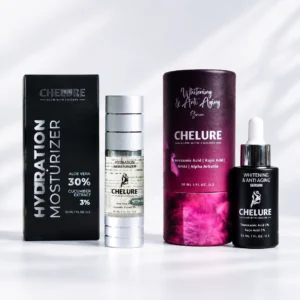
Set C: Brightening Serum + Hydration Moisturizer
How to use it
Evening first; after cleansing, a few drops on dry skin; start 2 to 3 evenings a week; moisturizer after; broad-spectrum sunscreen every morning; patch-test first; stop if skin burns or swells.
Who should speak to a doctor first
Pregnancy or breastfeeding, a history of blood clots or any clotting condition (especially before considering tablets), active eczema or open skin, or dark patches that appear suddenly, spread or look uneven in colour.
Frequently asked questions
What does tranexamic acid do for skin?
Tranexamic acid blocks plasmin, an enzyme involved in the signals that switch pigment production on after UV and inflammation. Doctors study it for melasma. In our serum it is one of four pigment-focused ingredients for dark spots and uneven tone. It is not a bleach.
Is tranexamic acid the same as hydroquinone?
No. Hydroquinone slows the pigment-making enzyme and is regulated as a medicine in many countries. Tranexamic acid is a different compound, originally a bleeding medicine, studied for the signals behind pigmentation. They are not interchangeable, and a skin doctor can advise which suits you.
How long does a tranexamic acid serum take to show results?
Trials of tranexamic acid for melasma ran from 8 weeks to nearly 2 years, and skin renews over weeks. Most people judge a brightening serum after 4 to 12 weeks of regular use with daily sunscreen. We cannot promise results, and cosmetic serums are not studied as melasma treatments.
Can I use tranexamic acid with kojic acid or alpha arbutin?
Our serum already combines them: tranexamic acid, kojic acid and alpha arbutin each act at a different step of pigment production. With AHAs added, the chance of irritation rises, so start every second evening, moisturize after, and wear sunscreen every morning.
Is tranexamic acid safe in pregnancy?
We found no pregnancy safety data for topical tranexamic acid in the reviews we read, so we cannot say it is safe. Our serum also contains AHAs and kojic acid. If you are pregnant or breastfeeding, please ask your doctor before using it.
Why shouldn’t I take tranexamic acid tablets for dark spots without a doctor?
Oral tranexamic acid is a prescription drug that affects blood clotting throughout the body, so doctors screen for clot history and hormone use first. Reviews report stomach discomfort and menstrual changes. A cosmetic serum is not the same thing, and tablets belong under a doctor’s care.
Can I use tranexamic acid with retinol?
Both can be used in one routine, but retinol and acids can dry or irritate skin. Use the serum on alternate evenings, keep retinol to the nights you are not using acids at first, moisturize, and wear sunscreen daily.
Sources
- Calacattawi R et al. Tranexamic acid as a therapeutic option for melasma management: meta-analysis and systematic review of randomized controlled trials. J Dermatolog Treat, 2024. PubMed 38843906
- Kim HJ et al. Efficacy and Safety of Tranexamic Acid in Melasma: A Meta-analysis and Systematic Review. Acta Derm Venereol, 2017. PubMed 28374042
- Konisky H et al. Tranexamic acid in melasma: A focused review on drug administration routes. J Cosmet Dermatol, 2023. PubMed 36606378
- Sarkar R et al. Topical and Systemic Therapies in Melasma: A Systematic Review. Indian Dermatol Online J, 2023. PubMed 38099013
- McKesey J et al. Melasma Treatment: An Evidence-Based Review. Am J Clin Dermatol, 2020. PubMed 31802394
- Saeedi M et al. A comprehensive review of the therapeutic potential of α-arbutin. Phytother Res, 2021. PubMed 33724594
- Kornhauser A et al. Applications of hydroxy acids: classification, mechanisms, and photoactivity. Clin Cosmet Investig Dermatol, 2010. PubMed 21437068
- Yasnova N et al. The effectiveness and safety of 3% tranexamic acid cream vs. 4% hydroquinone cream for mixed-type melasma in skin of color: a double-blind, split-face, randomized controlled trial. Acta Dermatovenerol Alp Pannonica Adriat, 2024. PubMed 38918942
- Liu Y et al. Comparison of the Efficacy of Melasma Treatments: A Network Meta-Analysis of Randomized Controlled Trials. Front Med (Lausanne), 2021. PubMed 34660626
- Austin E et al. Topical Treatments for Melasma: A Systematic Review of Randomized Controlled Trials. J Drugs Dermatol, 2019. PubMed 31741361
Related guides
- Tranexamic Acid Serum: How to Use It Safely (and Why Tablets Are Different)
- Tranexamic Acid Serum in Pakistan: Benefits, Who It Suits and Price
- Kojic Acid vs Tranexamic Acid: Which Fits Your Dark Spots?
- Vitamin C vs Tranexamic Acid for Dark Spots in Pakistan (and Kojic Acid)
- Melasma Treatment in Pakistan: Causes, Dermatologist Options and What Serums Can Do
- Pigmentation on the Face in Pakistan: Types, Causes and What Each Needs
More ingredient guides
This page is general information, not medical advice. See how we write and source our guides.