
Glycolic and Lactic Acid in Pakistan: Research and Our Serum

Brightening & Anti-Aging Serum
Short answer: Glycolic acid and lactic acid are alpha hydroxy acids (AHAs) that loosen dead surface cells so skin looks smoother and brighter. They also make skin more sensitive to sun, so daily sunscreen matters. Our Brightening & Anti-Aging Serum includes both AHAs alongside tranexamic acid, kojic acid and alpha arbutin.
Key takeaways
- AHAs act on the surface; they do not reach deep pigment.
- Glycolic acid is the smaller molecule and tends to be stronger; lactic acid is generally gentler and also holds water.
- Use sunscreen every morning; reviews emphasise sun-exposed-skin safety.
- Stinging, redness and peeling are signs to slow down.
What AHAs are
Alpha hydroxy acids are acids that weaken the bonds between dead skin cells on the surface. Glycolic acid comes from sugar cane in cosmetic form; lactic acid comes from fermentation. A review of hydroxy acids (Clin Cosmet Investig Dermatol 2010, PMID 21437068) classifies alpha, beta and polyhydroxy acids, describes their cosmetic and therapeutic uses, and gives particular attention to safety with prolonged use on sun-exposed skin. It notes that their biological mechanisms still need clarification.
What the research says
| Source | What it covered | What it found |
|---|---|---|
| Hydroxy acids review, 2010 (PMID 21437068) | Classes, uses and safety of hydroxy acids | Wide cosmetic and clinical use; safety on sun-exposed skin needs attention; mechanisms need clarifying |
| Organic acids for chemical peels in acne, Molecules 2023 (PMID 37894698) | Bibliographic review of organic acids used in peels | Reviews acid options for acne peels; mostly in-clinic strengths, not home serums |
| Lactic acid and melanogenesis, Curr Pharm Biotechnol 2020 (PMID 31916515) | Lactic acid and bacteria for skin health | States that histological evidence indicates topical lactic acid is effective for depigmentation and for improving surface roughness and mild wrinkling from photo-damage |
How to read it: most strong data come from clinic peels at higher strengths. A home serum uses lower strengths, so we cite the research to explain what the ingredient is, not to claim peel-level results.
Glycolic vs lactic acid
Glycolic acid has the smallest molecule of the AHAs and penetrates easily, so it tends to be stronger and more likely to sting. Lactic acid is a larger molecule, usually milder, and also draws water into skin. Using both in a low-strength serum is a way of balancing exfoliation and comfort. The AHA percentages are not printed on our product page, so we do not state any here.
Why Chelure’s serum includes AHAs
The Brightening & Anti-Aging Serum (30 mL, Rs 2,500) combines:
- Glycolic and lactic acid for the surface: dull skin cells loosen so other ingredients spread evenly.
- 3% tranexamic acid, 3% kojic acid and alpha arbutin for pigment production (see their hubs).
- Glycerin and sodium PCA to hold water during exfoliation.
- Licorice, bearberry, allantoin and vitamin E to soothe.
What happens when they are combined
No trial exists of this exact formula. The reasoning: removing dull surface cells helps the brightening ingredients reach the skin more evenly and improves texture; water-holding ingredients and soothing extracts offset dryness. Combining several actives raises irritation risk, so start every second evening, moisturize and wear sunscreen.
Price comparison
| Product | Size | Price | Per mL |
|---|---|---|---|
| Chelure Brightening & Anti-Aging Serum (with glycolic and lactic acid, plus three pigment ingredients) | 30 mL | Rs 2,500 | about Rs 83 |
| Imported 7% glycolic acid toning solution | 240 mL | Rs 3,300 to Rs 7,950 (Pakistani online retailers, checked 3 Nov 2026) | about Rs 14 to Rs 33 |
A glycolic toner in a large bottle costs much less per mL. It is a single acid in a different format (a toner), so it is not a like-for-like comparison with a brightening serum.
Glycolic acid peels in melasma: what the research covers
Most of the clinical research on these acids is about peels done in a clinic, not leave-on serums. A systematic review of chemical peels for melasma covered 24 studies and 1,075 participants over 8 to 36 weeks, found glycolic acid to be the most safe and effective of the peels studied, and could not pool the results because the studies were too different (PMID 38530985). A randomized trial in 40 people (34 completed) compared 80% lactic acid peels with 50% glycolic acid peels, four sessions two weeks apart; the median fall in the melasma score was larger with glycolic acid (2.85 against 1.8) (PMID 40487492). A small study of 10 Asian women used a cream with 10% glycolic acid and 2% hydroquinone twice daily plus peels of 20% to 70% every three weeks on one side of the face; both sides improved and the peeled side did a little better, though not significantly (PMID 9145959).
Peels of 20% to 80% applied by a doctor are very different from a leave-on serum, so these studies do not show that our serum treats melasma. They show why AHAs are part of brightening routines: they speed up the shedding of surface cells that hold pigment.
Why daily sunscreen is not optional
In a randomized, double-blind study of 29 people, 10% glycolic acid at pH 3.5 was applied to the back six days a week for four weeks. Afterwards, glycolic acid-treated skin showed more sunburn cells and a lower threshold for sunburn after UV exposure than skin treated with placebo, and the effect cleared within a week of stopping (PMID 12713551). So AHAs are a reason to be strict with sunscreen, to reapply when outdoors, and to avoid the strongest midday sun while your skin is adjusting. See our guide to choosing a sunscreen for oily skin.
Glycolic and lactic acid together
Glycolic acid has the smallest molecule of the AHAs and tends to be the strongest, while lactic acid is larger, usually milder, and draws water into skin. A review of lactic acid for skin health notes histological evidence that topical lactic acid improves depigmentation, surface roughness and mild wrinkling from sun damage (PMID 31916515). Using both at low strength in a serum is a way to balance exfoliation and comfort.
How to introduce an AHA serum without irritating your skin
| Weeks | How often | Notes |
|---|---|---|
| 1 to 2 | 2 evenings a week | On clean, dry skin; moisturizer after |
| 3 to 4 | 3 evenings a week | Only if skin feels comfortable the next morning |
| 5 onward | Every second evening at most | Daily use is not necessary for most people |
- Slow down if you notice stinging that lingers, tightness, redness or heavy flaking.
- Do not use it on the same night as retinol or another exfoliating acid while you are starting.
- Skin that is sunburnt, waxed or broken should be left alone until it heals.
- If breakouts appear in new places, or get worse over several weeks, see our guide on purging versus a breakout.
Reading the label: AHAs and look-alikes
- Glycolic acid, lactic acid, mandelic acid and citric acid are all alpha hydroxy acids. Salicylic acid is a beta hydroxy acid, a different class.
- The strength printed for an AHA is only part of the picture, because how much acid is active also depends on how the formula is made. We do not print AHA strengths for our serum, so this page makes no strength comparisons.
- Toners and washes are rinse-off or short-contact formats. A glycolic toner in a large bottle is not the same product as a leave-on serum.
Common mistakes with AHA serums
- Using them every night from the first week.
- Combining with retinol, another acid or a scrub on the same night.
- Going out without sunscreen. The study above found sun sensitivity within four weeks of use.
- Scrubbing at flaking skin. Flaking means slow down, not exfoliate more.
- Expecting an AHA to fade deep or hormonal pigment. Surface turnover helps the look of dullness and marks, and melasma needs a doctor.
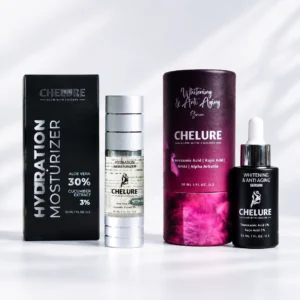
Set C: Brightening Serum + Hydration Moisturizer
How to use it
Evening, after cleansing; a few drops; start 2 evenings a week; moisturizer after; sunscreen every morning; do not combine with another exfoliating acid or retinol on the same night at first.
Who should speak to a doctor first
Pregnancy or breastfeeding, broken or sunburnt skin, active eczema, or skin that burns or swells after use.
Frequently asked questions
What does glycolic acid do for skin?
Glycolic acid is an alpha hydroxy acid that loosens the bonds between dead surface cells, so skin looks smoother and brighter. Reviews note its biological mechanisms still need clarifying and that safety on sun-exposed skin needs attention. It acts on the surface, not on deep pigment.
Glycolic vs lactic acid: which is gentler?
Glycolic acid has the smallest molecule of the AHAs and penetrates easily, so it tends to be stronger and more likely to sting. Lactic acid is larger and usually milder, and it also draws water into skin. Using both at low strength balances exfoliation and comfort.
Do AHAs make skin sun-sensitive?
Hydroxy acids can leave skin more sensitive to the sun, and reviews give special attention to safety with prolonged use on sun-exposed skin. Wear a broad-spectrum sunscreen every morning when using an AHA serum.
Can I use AHAs with retinol?
Avoid using AHAs and retinol on the same night at first, because both can dry and irritate skin. Use the serum on some evenings and retinol on others, moisturize, and wear sunscreen daily. Stop if skin burns, blisters or swells.
Why does my skin peel with AHAs?
AHAs speed up shedding of dead surface cells, so mild flaking or tightness can happen when you start. Stinging, redness or burning means slow down. If skin does not settle, stop and see a doctor. Moisturize and use sunscreen every morning.
How often should I use an AHA serum?
Start with 2 evenings a week and build up only if your skin stays comfortable. Do not combine with other exfoliating acids or retinol on the same night at first. More often is not better. Follow with moisturizer and use sunscreen every morning.
Sources
- Kornhauser A et al. Applications of hydroxy acids: classification, mechanisms, and photoactivity. Clin Cosmet Investig Dermatol, 2010. PubMed 21437068
- Măgerușan ȘE et al. A Comprehensive Bibliographic Review Concerning the Efficacy of Organic Acids for Chemical Peels Treating Acne Vulgaris. Molecules, 2023. PubMed 37894698
- Huang HC et al. Lactic Acid Bacteria and Lactic Acid for Skin Health and Melanogenesis Inhibition. Curr Pharm Biotechnol, 2020. PubMed 31916515
- Sarkar R et al. Chemical Peels for Melasma: A Systematic Review. Dermatol Surg, 2024. PubMed 38530985
- Kadu PP et al. 80% Lactic Acid Peel Versus 50% Glycolic Acid Peel for Melasma: A Randomised Clinical Trial. Indian J Dermatol, 2025. PubMed 40487492
- Lim JT et al. Glycolic acid peels in the treatment of melasma among Asian women. Dermatol Surg, 1997. PubMed 9145959
- Kaidbey K et al. Topical glycolic acid enhances photodamage by ultraviolet light. Photodermatol Photoimmunol Photomed, 2003. PubMed 12713551
Related guides
- Mandelic Acid Serum in Pakistan: Price, Benefits and vs Salicylic Acid
- Skin Purging vs Breakout: How to Tell the Difference
- Skincare Routine Order in Pakistan: Morning and Night, Step by Step
- Why Pakistani Skin Gets Dark Spots, and What Actually Helps
- Tan Removal for the Face in Pakistan: Cream, Soap, Face Wash or Mask?
More ingredient guides
This page is general information, not medical advice. See how we write and source our guides.